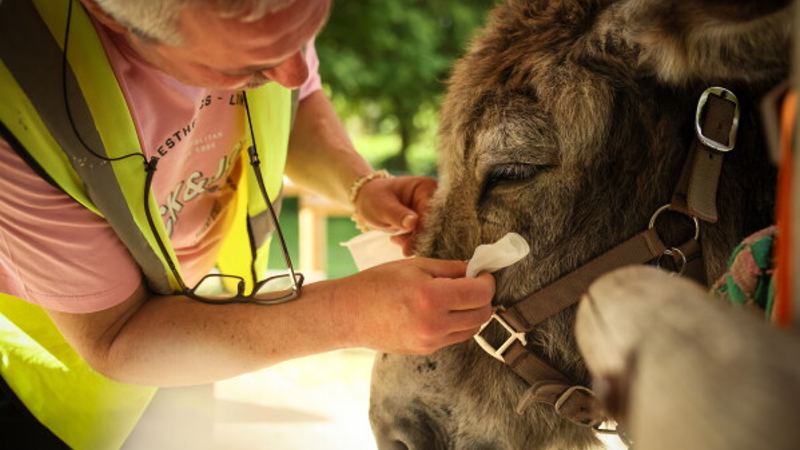
Patients with mental health conditions at Ville-Evrard hospital, a psychiatric facility outside Paris, are finding therapeutic benefit through an animal therapy program centered on donkeys—a unique initiative in France that staff view as a promising complementary treatment model.
The program began in 2016 when nurse specialist Ermelinda Hadey and her husband François launched the therapy using five donkeys (Nono, Pitou, Oscar, Manolo, and Malraux). Patients participate free of charge as part of their publicly funded treatment. Sessions typically pair each participant with a donkey, and over time they develop familiarity with each animal’s personality. During a recent Friday session, patients walked the donkeys and cared for them, with some confidently lifting their hooves to remove dirt, while many ended the session with a hug.
Observable Improvements
Audrey Seffar, a nurse at the animal therapy unit, noted significant progress in some patients. In one case, a 60-year-old woman named Nathalie initially refused to leave a cart provided for people with physical difficulties. “Little by little, with encouragement, she did,” Seffar said. “The animal serves as a mediator. It’s such an extraordinary one that today she was able to leave the cart and stand beside her donkey.”
Jérôme, a 52-year-old patient, reported that the program reduces his loneliness. “Talking with people, taking part in activities I wouldn’t normally do, it helps me in my daily life,” he said, adding: “It helps you break away from the routine of treatment and medication.”
Clinical Recognition and Expansion
Since 2022, the animal therapy program has held official status as a healthcare unit, allowing it to employ three full-time nurses. The program has expanded beyond donkeys to include guinea pigs, chickens, doves, goats, turtles, and rabbits. François Hadey described donkeys as “emotional sponges” that understand things quickly and connect well with patients once involved in interactions.
Sessions are designed as therapeutic interventions for anxiety, depression, autism, schizophrenia, and other conditions, with staff saying they help improve emotional regulation, communication, social interaction, and self-esteem. The couple’s goal is formal psychiatric recognition, though they acknowledge that more scientific evaluation is needed. As Ermelinda Hadey stated, the therapy “does not replace a doctor or a medical prescription, but it can help patients regain confidence and a sense of self-worth.”
This article is an AI-assisted summary. All facts and figures are drawn from the original report: https://apnews.com/article/france-donkey-therapy-mental-health-hospital-a751b540ba27e82797a2cf5a64baf045