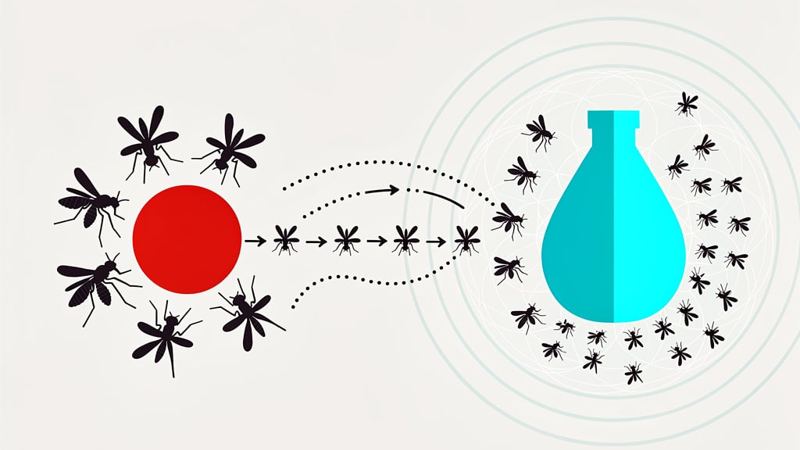
A new study reveals that mosquitoes can be conditioned to seek out DEET rather than avoid it, challenging assumptions about one of the world’s most widely used insect repellents. Researchers at Virginia Tech and the University of Tours in France trained female Aedes aegypti mosquitoes using Pavlovian conditioning, pairing DEET exposure with blood meals or sugar rewards.
Learned Preference for Repellent
After four repetitions of the conditioning protocol, more than 60 percent of mosquitoes extended their proboscis and attempted to feed when presented with the DEET smell alone. When offered a choice between two human hands behind a mesh barrier—one treated with DEET and one untreated—conditioned mosquitoes showed a clear preference for the treated hand, approaching it more readily and probing more often. The findings appear in the Journal of Experimental Biology.
Associate Professor Clément Vinauger stated: “Mosquitoes are very smart and can outsmart our control tools. DEET is a molecule that can be interpreted by the mosquito brain, and mosquitoes can learn to like it.” He explained that when DEET concentration fades over time but a mosquito still manages to feed, the insect may begin associating that smell with a reward, a scenario with real-world implications for how repellents are used.
Broader Adaptive Challenges
The findings add to existing concerns about mosquito resilience. A 2013 study from the London School of Hygiene and Tropical Medicine found that roughly half of Aedes aegypti lost their aversion to DEET after three hours of exposure. Genetic resistance has also surfaced in some strains. Meanwhile, habitat loss pushes mosquitoes toward human hosts—a January 2026 study in Brazil’s Atlantic Forest documented how shrinking biodiversity forces insects to feed more on people as animal options decline.
The Centers for Disease Control and Prevention continues to endorse DEET and other EPA-registered repellents, with protection peaking around 50 percent concentration. Reapplication remains essential after swimming, heavy sweating, or prolonged activity. Researchers stress that DEET retains value when applied correctly but warn against inconsistent use that might reinforce mosquito learning. Scientists are exploring alternatives, including natural compounds and machine learning approaches to identify new molecules potentially 100 times more effective against resistant strains.
This article is an AI-assisted summary. All facts and figures are drawn from the original report: https://www.webpronews.com/mosquitoes-learn-to-crave-deet-new-study-shows-repellents-unexpected-vulnerability-2/