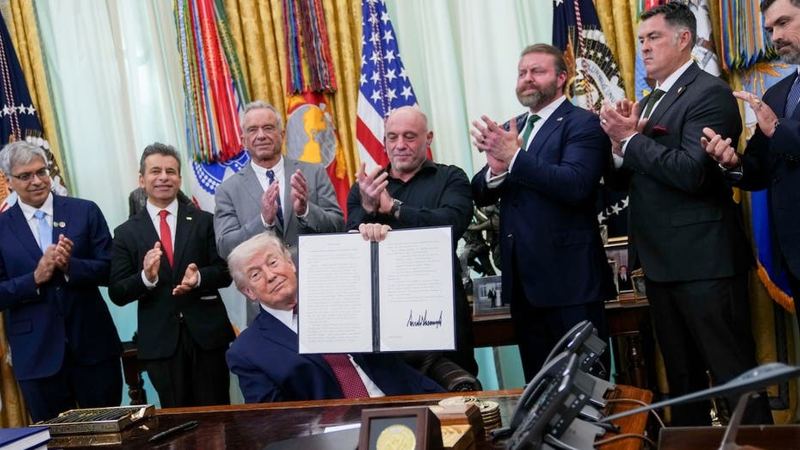
President Trump signed an executive order to fast-track the research, funding, and potential FDA approval of psychedelics including ibogaine, psilocybin, LSD, and MDMA, primarily to treat PTSD, depression, and addiction. Psychedelics are psychoactive compounds that act largely through serotonin pathways and are being studied in controlled clinical settings for mental health treatment.
Supporters praise the move’s potential to transform mental health treatment, particularly for veterans. Jay Kopelman, former Marine Corps lieutenant colonel and CEO of Mission to Live Foundation, stated: “The president’s action today opens a pathway to research that will further open doors to expedited approval of this life-saving medicine as a treatment for our veterans—and society—who have suffered for decades from treatment-resistant PTSD, TBI and depression.” Dr. Marc Siegel, Fox News senior medical analyst, agreed that psychedelics hold “big potential” for severe depression and PTSD, noting they “change brain chemistry in a way that can provide more modulation of dopamine, serotonin and other neurochemicals, making a patient less fearful.”
However, critics express concerns about safety and evidence. Kevin A. Sabet, Ph.D., president and CEO of the Foundation for Drug Policy Solutions, stated: “President Trump’s executive order on ibogaine puts politics and hype ahead of science by suggesting that a dangerous, unapproved hallucinogen can somehow be a medical treatment.” He noted ibogaine remains a Schedule I substance with serious safety concerns, including documented cardiotoxicity and deaths. Kopelman acknowledged that the primary risk of ibogaine is its “cardiotoxicity properties,” which “can prolong the QT interval in the heartbeat, which can lead to arrhythmia or even heart attack,” though this risk is mitigated by “rigorous medical examinations” and monitoring during treatment.
Experts emphasize that these treatments require careful administration. Juliana Mercer, executive director of a nonprofit advancing psychedelic-assisted therapy for veterans, stated that treatments “should only be administered in controlled clinical settings by trained providers.” Siegel cautioned that “unfettered recreational use and microdosing can increase the risk of psychosis and other anxiety disorders.” Kopelman stressed that “the real work begins after treatment,” emphasizing “post-medicine integration work that requires multiple therapy sessions overseen by a trauma-informed psychedelic therapist.” He added: “Psychedelics are not a panacea. They are a gateway to healing.”
This article is an AI-assisted summary. All facts and figures are drawn from the original report: https://www.foxnews.com/health/trump-backed-plan-could-fast-track-psychedelic-therapies-heres-what-know