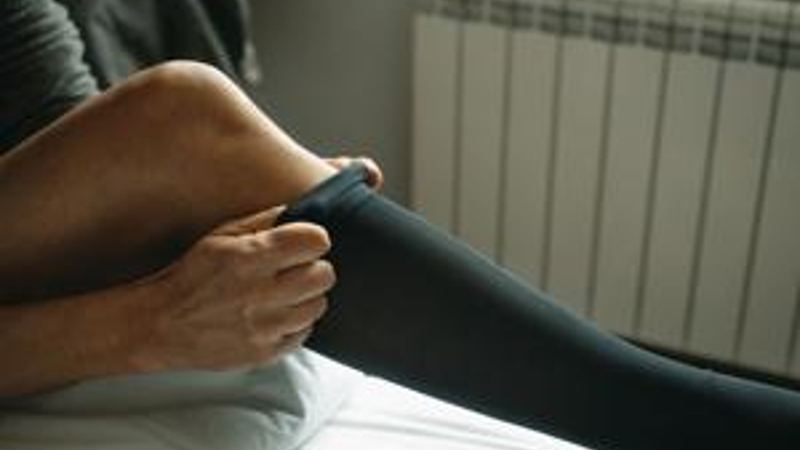
Compression socks are tight stockings that put pressure on the legs to prevent and treat edema, or swelling, and to prevent blood clots. Some extend just to the knee, some above the knee, and others go all the way up to the abdomen. Some compression socks work on a gradient, with pressure highest at the ankle and gradually decreasing higher up the leg, while others have consistent pressure throughout.
According to Dr. Robert H. Shmerling, senior faculty editor at Harvard Health Publishing and former clinical chief of Rheumatology at Beth Israel Deaconess Medical Center, “there’s generally not consensus in the medical world that the average person needs to wear compression stockings.” However, compression socks are a standard treatment for certain health conditions.
How Compression Socks Work
Compression socks squeeze the blood vessels in the legs to improve circulation, reduce swelling, and potentially relieve leg pain. Blood must flow against gravity to return to the heart, and leg veins have special valves to prevent it from flowing backward. With leg muscle contractions, blood moves through these valves and toward the heart. In some people, these valves fail over time in a condition called venous insufficiency, causing blood and fluid to pool in the legs and create swelling. Compression socks help the valves in blood vessels do their job by squeezing the legs.
Who Should Use Them
Compression socks are a standard treatment for chronic venous insufficiency, varicose veins, and leg edema. They are also used to prevent deep vein thrombosis, or blood clots in the legs, for people at high risk. Older adults prone to leg edema benefit from compression socks if they are obese, have experienced previous blood clots or leg injuries, or are bedridden. Younger people who benefit are typically those with certain health conditions or pregnant women. A primary care physician can help determine if compression socks could treat edema, varicose veins, or prevent swelling or blood clots.
Wearing and Care
Because of their snug fit, compression socks can be difficult to put on. Tips include bunching the socks and turning the toe inside out before putting the foot in, trimming toenails, wearing rubber gloves, using powder like cornstarch to absorb moisture, and using a donner device to help hold socks open. It’s best to put on compression socks when you first wake up, when legs are least swollen. Wear them all day while upright, but remove them at night when lying down.
This article is an AI-assisted summary. All facts and figures are drawn from the original report: https://mtstandard.com/brandavestudios/sponsored/article_c8cdd1e8-c50a-44d3-9857-651a32393ce9.html