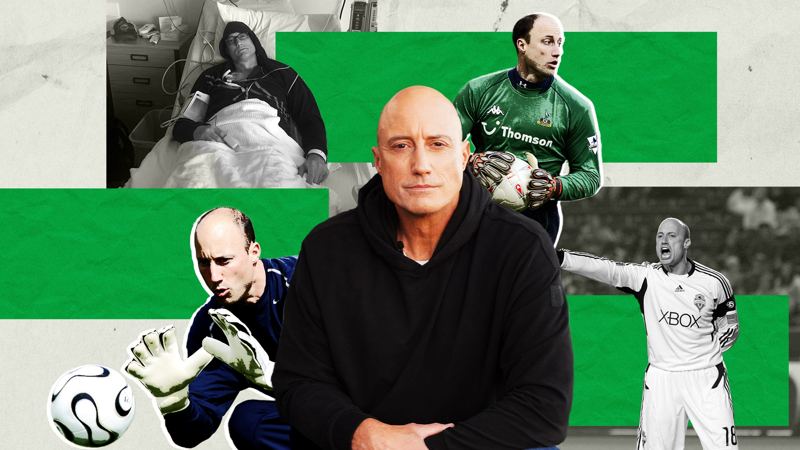
Former U.S. Men’s National Team goalkeeper Kasey Keller has revealed that he played through his final professional soccer season with undiagnosed Non-Hodgkin’s lymphoma, completing the 2011 season with the Seattle Sounders while managing his cancer diagnosis. Keller, 56, spent 17 years playing professionally across the U.S. and Europe, including 12 years as starting goalkeeper for the national team, playing in four World Cup tournaments.
Keller’s diagnosis came in 2010 after an MRI scan to investigate hip pain revealed a blood cancer that had been asymptomatic. “I said, ‘Doc I’ve had a lot of MRIs, and nobody’s ever asked me if I had lunch afterward,’” Keller recalled about his doctor’s unusual phone call. A biopsy confirmed Non-Hodgkin’s lymphoma, with an oncologist advising him to wait and monitor rather than immediately begin treatment. Keller admits he felt conflicted about his diagnosis considering he had one more year remaining on his contract with the Sounders, but he completed his final season, finishing with a 1.09 goals against average and 18 wins, earning the 2011 MLS goalkeeper of the year award.
Keller attributed his ability to perform with cancer to his experience as a professional athlete. “So much of pro sports is being able to control the controllables,” he said, explaining how he approached his cancer diagnosis similarly to how he managed pressure on the field. “As a pro-player, you learn to compartmentalize those types of things.” After retiring, Keller worked as an analyst and commentator for ESPN and Seattle Sounders broadcasts without beginning treatment for eight years after his initial diagnosis.
Treatment and Recovery
Warning signs eventually emerged, including unexplained weight loss and a noticeable bump on his groin. Keller began treatment in early March 2018 after blood tests showed concerning results. His cancer had progressed to a more aggressive form: large B-cell lymphoma. After multiple treatments with limited success, Keller became eligible for Breyanzi, a CAR T-cell therapy from Bristol Myers Squibb. The drug collects and genetically modifies a person’s white blood cells to become CAR T cells that recognize and attack lymphoma. After the infusion, Keller experienced a severe fever of 102.5°F that required hospitalization for five days, but two months after treatment, he was declared “no evidence of disease.” Keller continues to be in remission and has partnered with Bristol Myers Squibb to share his experience with others.
This article is an AI-assisted summary. All facts and figures are drawn from the original report: https://www.menshealth.com/health/a70235087/soccer-player-kasey-keller-non-hodgkins-lymphoma-diagnosis/