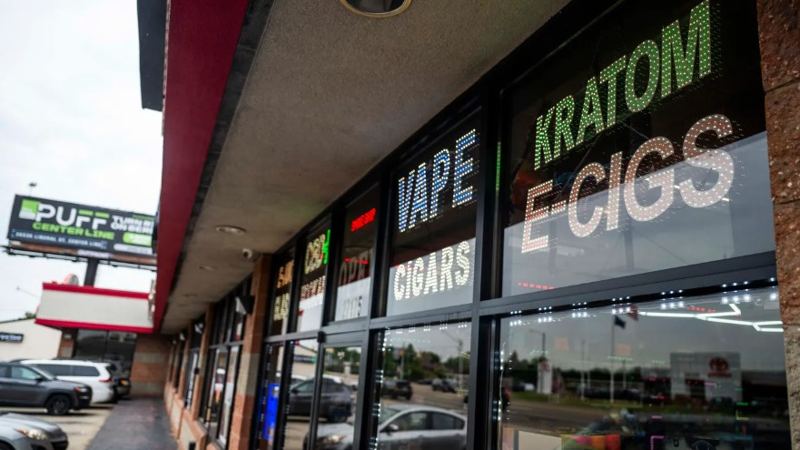
Clinton Township is considering an ordinance to restrict kratom sales to those 21 and over, positioning the community as potentially the first in the county and perhaps the state to regulate the herbal supplement. The move reflects growing concerns about kratom’s addictive properties and aggressive marketing targeting youth.
The Proposed Ordinance
Township Trustee Shannon King proposed an ordinance that would restrict kratom sales to those 21 and older—aligning with state law for alcohol and marijuana. A violation would be a civil infraction carrying a $500 fine. King emphasized that kratom, sold in smoke shops, party stores, vitamin shops, and gas stations, is currently unregulated and “marketed to youth with its colorful, creative packaging” in a pattern reminiscent of cigarette advertising before the 1971 restriction on such ads. “Just like they were doing cigarettes once upon a time, it is being marketed to a younger generation with cartoon-type of things,” King said.
Support from Experts and Courts
The CARE of Southeast Michigan organization and nursing professor Elizabeth Lucas have expressed concerns about kratom’s addictive potential. Lucas compared kratom to opioids like fentanyl, stating: “You can very easily become addicted. You can go through withdrawal and can overdose because it hits those same receptors as fentanyl does.” Kara Hartman, director of specialty courts at 41B District Court in the township, called kratom “a nightmare” and noted that when participants in the district’s treatment courts are tested for it, 10% to 20% test positive. The testing costs $40 per person—more than double the $26 cost for other substances—which limits routine screening. One specialty court participant overdosed on kratom and spent two weeks in a hospital.
The Drug Itself
Kratom is an herbal extract from the leaves of Mitragyna speciosa, an evergreen tree native to Southeast Asia. The Mayo Clinic calls it “unsafe and ineffective,” despite users claiming benefits for mood and energy. The leaves contain mitragynine and 7-hydroxymitragynine (7-OH), an opioid-like chemical that binds to the same brain receptors as opioids. In July, the FDA recommended a “scheduling action” to control 7-OH in its concentrated form. FDA Commissioner Dr. Marty Makary stated: “Vape stores are popping up in every neighborhood in America, and many are selling addictive products like concentrated 7-OH. After the last wave of the opioid epidemic, we cannot get caught flat-footed again.” Reported side effects include high blood pressure, confusion, seizures, weight loss, liver damage, hallucinations, and trouble breathing. Twenty-four states and the District of Columbia have already passed kratom regulations, some including outright bans.
Opposition and Ongoing Debate
The American Kratom Association characterizes FDA actions as “their war on kratom” and promotes kratom as a “natural plant that helps consumers improve their health and well being for centuries.” The Holistic Alternative Recovery Trust argues that concentrated 7-OH products should be distinguished from natural kratom products and labeled accordingly, calling efforts to ban 7-OH “largely driven by a kratom organization that views 7-OH as a threat to its market share.”
This article is an AI-assisted summary. All facts and figures are drawn from the original report: https://www.macombdaily.com/2026/01/11/clinton-township-to-consider-21-and-over-restriction-on-kratom/