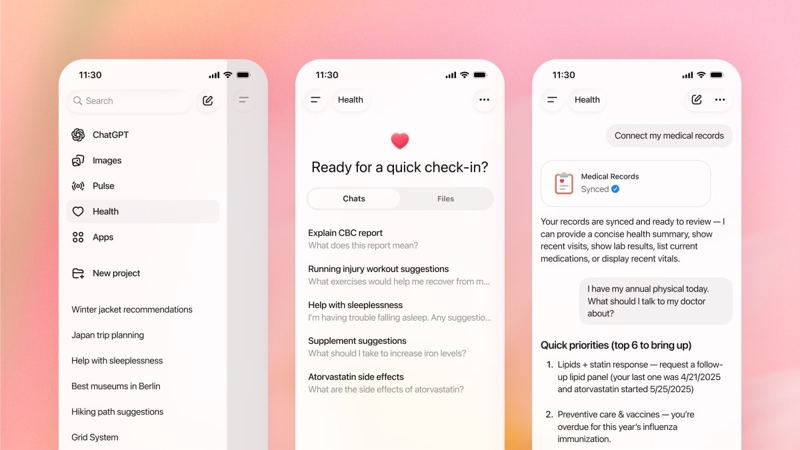
OpenAI announced on Jan. 7 that ChatGPT Health will soon roll out as a dedicated tab allowing users to upload medical records and connect health apps including Apple Health, Function, and MyFitnessPal. The company reports that more than 40 million people ask ChatGPT health-related questions daily, representing more than 5% of all global messages on the platform.
What ChatGPT Health Offers
The new feature functions as a hub where users can upload medical records—including lab results, visit summaries, and clinical history—so the AI tool responds to questions “grounded in the information you’ve connected.” OpenAI suggests example queries like “How’s my cholesterol trending?” and “Can you summarize my latest bloodwork before my appointment?” Users can also sync with Apple Health for activity data, Function for blood markers and clinician suggestions, MyFitnessPal for nutrition advice, and Weight Watchers for GLP-1-focused meal ideas. OpenAI states the tool is designed to support healthcare, not replace it, and spent two years consulting with more than 260 physicians across dozens of specialties.
Privacy and Security Concerns
OpenAI partnered with b.well to securely connect medical records and implemented “enhanced privacy” features including separate chat history and memory from other tabs. The company stated that “conversations in Health are not used to train our foundation models” and Health information won’t flow into non-Health chats. However, experts urge caution. Dr. Bradley Malin of Vanderbilt University Medical Center notes that no federal regulatory body governs health information provided to AI chatbots, and ChatGPT services fall outside HIPAA scope. “It’s a contractual agreement between the individual and OpenAI at that point,” Malin says. “If you are providing data directly to a technology company that is not providing any health care services, then it is buyer beware.” In a data breach, users would have no specific HIPAA rights, though the Federal Trade Commission could intervene or users could sue directly.
Accuracy and Best Practices
Research by Dr. Danielle Bitterman found that AI models prioritize being helpful over medical accuracy and always supply answers, even when inaccurate. Studies show that missing medical record information increases hallucination risks. According to the National Institute of Standards and Technology, incomplete data leads to inaccurate results. Dr. Adam Rodman advises against autonomous medical decisions but supports using ChatGPT for lower-risk matters like diet and exercise planning or brainstorming doctor appointment questions—ideally without uploading full medical records.
This article is an AI-assisted summary. All facts and figures are drawn from the original report: https://time.com/7344997/chatgpt-health-medical-records-privacy-open-ai/