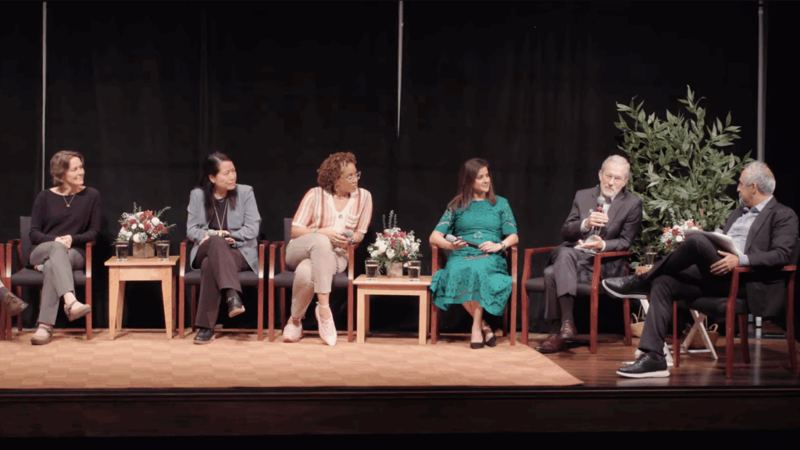
A panel of leaders from academia and industry discussed research showing that kindness is a strategic business asset rather than a professional weakness. The event, held Dec. 1, featured UC Berkeley Chancellor Rich Lyons, HubSpot CEO Yamini Rangan, and neuroscientist Emiliana Simon-Thomas among panelists examining how prosocial leadership produces measurable business results.
The Science of Prosocial Leadership
Research by Weili Ge, a professor at the University of Washington’s Foster School of Business, analyzed a decade of data on 3,500 corporate leaders. When companies perform well, prosocial CEOs are more likely to share credit with others. When firms don’t perform well, they’re less likely to shift blame and more likely to take responsibility—quite different from self-centered CEOs, who are more likely to take credit when things go well and shift blame when things don’t.
Emiliana Simon-Thomas, science director at UC Berkeley’s Greater Good Science Center, explained that kindness involves making wellbeing a priority for oneself and others. While humans are wired for both defensive and kind responses, kindness is the slow, enduring pathway that enables coordination and collective goals. Humans are an ultra-social species who need each other; isolation or feeling unseen registers as physical pain in the nervous system and is deleterious to health and wellbeing.
Practical Applications in Leadership
UC Berkeley Chancellor Rich Lyons described leadership as comprising direction-setting, operational leadership, and people leadership. At Berkeley, a shared governance model requires acceptance and relatability from faculty rather than command-and-control—elements he defines as the “acceptance” component of an effectiveness equation. “You can’t get stuff done at Berkeley without A, and I don’t think you can get A done without kindness,” he noted.
HubSpot CEO Yamini Rangan emphasized simple acts of kindness in daily practice. She resets after every meeting to ensure previous conversations don’t impact her next interaction, and she prepares thoroughly for meetings as a sign of respect. “When people send me briefs or documents, I show respect by reading them completely and thoroughly,” she said. “When I show up with presence and with preparation, it’s an act of kindness.”
KeyAnna Schmiedl, chief human experience officer at Workhuman, highlighted that kind leadership allows leaders to be authentic rather than code-switching, which reduces stress and builds deeper relationships while accelerating work completion.
This article is an AI-assisted summary. All facts and figures are drawn from the original report: https://news.berkeley.edu/2026/01/09/berkeley-talks-kind-leaders/