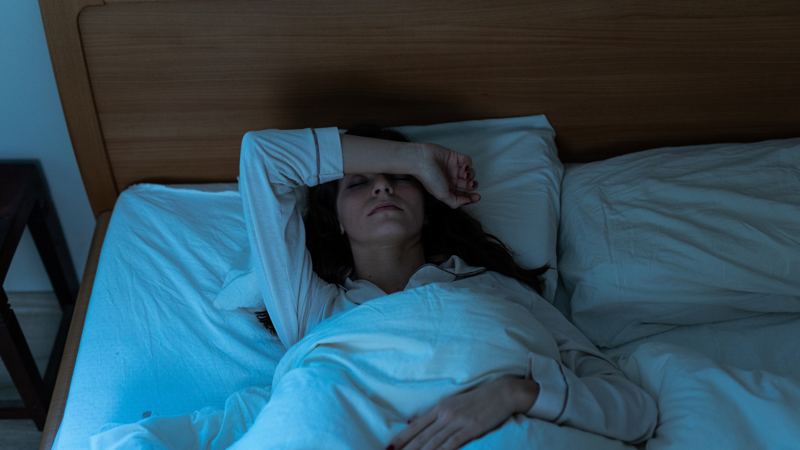
Nighttime anxiety affects a substantial portion of the population, with 68% of Americans reporting sleep loss due to anxiety according to the American Academy of Sleep Medicine, and 79% of people struggling to switch off at bedtime according to a UK survey. Sleep expert Heather Darwall-Smith explains that “when anxiety kicks off, the brain boots up the alarm system” with stress hormones cortisol and adrenaline flooding the body, heart rate increasing, and core temperature rising—all opposite to what sleep requires. This creates a feedback loop where poor sleep worsens anxiety, which then worsens sleep further.
The 4-7-8 Breathing Technique
The 4-7-8 breathing method, rooted in yogic breathing traditions and popularized by Dr. Andrew Weil, offers a practical tool for managing nighttime anxiety. According to Dr. Weil, it is “the most powerful anti-anxiety measure [he’s] ever come across.” The technique works by activating the parasympathetic nervous system—the body’s rest and recovery mode—and switching off the sympathetic nervous system’s stress response. Dr. Carleara Weiss, sleep science advisor at Aeroflow Sleep, explains it aids “sleep onset by helping the body transition from the high-stress, hypervigilant fight-or-flight state into a resting, relaxing state” and manages “intrusive thoughts and overthinking which often accompany nighttime anxiety.” To practice: sit or lie comfortably, place your tongue just behind your upper front teeth, exhale fully through your mouth, then inhale through the nose for a count of 4, hold for 7, and exhale through the mouth for 8. This counts as one cycle; aim for four cycles, keeping the 4-7-8 ratio rather than focusing on absolute speed.
Supporting Strategies for Better Sleep
Beyond breathing techniques, multiple approaches combat nighttime anxiety. A consistent nighttime routine or “brain reset” 30 to 60 minutes before bed—involving relaxation techniques, meditation, yoga, or journaling with reduced light and no screens—helps close the mind’s open “tabs.” Keep the bedroom cool, ideally between 65 to 70°F (18 to 21°C), or slightly cooler at 61 to 65°F (16 to 18°C) for those with anxiety, as core temperature naturally drops during sleep. A warm bath or shower 1 to 2 hours before bed is among the most evidence-backed sleep interventions available. Avoid caffeine after midday, as it has a half-life of 5 to 7 hours and remains active at bedtime. Avoid alcohol despite its initial sedative effect, as it suppresses REM sleep and produces anxious early-morning waking. If unable to sleep after about 20 minutes, get up and move to another room to do something quiet in dim light until genuinely sleepy, then return to bed. This breaks the association between bed and wakefulness.
This article is an AI-assisted summary. All facts and figures are drawn from the original report: https://www.tomsguide.com/wellness/sleep/nighttime-anxiety-was-stopping-me-from-sleeping-but-this-doctor-recommended-trick-helps-me-fall-asleep-fast-heres-how-to-do-it