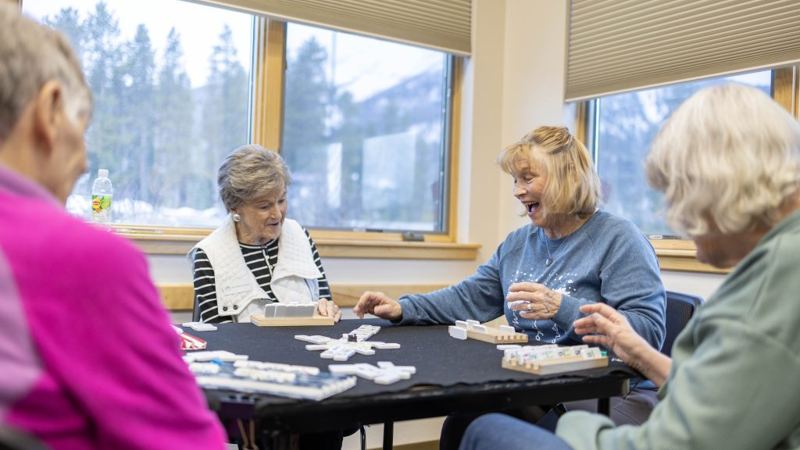
Experts and older residents in Summit and Grand counties say physical fitness, social engagement, and financial planning are essential to aging successfully in mountain communities. Andy Searls, 89, who helped found the nonprofit Staying in Summit in 2018 to advocate for expanded senior services, has largely thrived while aging in place, though she stopped skiing about a year and a half ago following hip replacement surgery.
Physical Activity and Mountain Living
Medical professionals emphasize that staying active is critical for aging adults in high-elevation communities. Jason Cleckler, CEO of Middle Park Health, noted that older patients often pursue orthopedic procedures specifically to maintain outdoor activities: “A lot of times it’s somebody (saying), ‘I want to get my knee done because I want to mountain bike this summer,’ or you know, ‘I need my hip replaced, and I want to do it before the snow falls. I want to ski again.’” Cal Cherrington, a former gym owner who won the title of “Fittest Man on Earth” in his CrossFit age class, observed that mountain living itself demands physical activity. “It takes work to live here,” he said. “You cannot go out in the winter without shoveling the front stoop, scraping down the car windshield.”
Dr. Rebecca Smiley, chief medical officer of CommonSpirit St. Anthony Summit, warned that inactivity accelerates decline in older adults. “If you stop moving, everything is going to become harder for you,” she said. She also emphasized fall prevention, as injuries in older adults often lead to prolonged recovery periods and deconditioning—the loss of heart, lung capacity, and muscle mass from disuse.
High-altitude specialists note that oxygen supplementation at night helps residents prevent health issues. Dr. Maximiliano Smolkin said most mountain residents in Colorado should use a liter or more of oxygen nightly, as low oxygen levels can cause hypoxia and lead to conditions like pulmonary hypertension and congestive heart failure.
Social Connection and Housing Costs
Social isolation poses significant mental and physical health risks. Philip Mervis, president of Summit 50 Plus, noted that medical studies show people with strong social connections have lower risks of dementia or Alzheimer’s disease. Summit 50 Plus charges $25 per year for membership and offers programming ranging from weekly community dinners to bridge games and book clubs.
Financial planning is critical given mountain living costs. According to the Harvard University Joint Center for Housing Studies, nationally only 13% of people 75 and older could afford assisted living in their area. In Colorado, median monthly long-term care costs are $6,070 for assisted living, $7,270 for memory care, and $3,498 for independent living, with home care at $40 per hour. Cliffview assisted living center charges $4,100 monthly for single rooms and $7,060 for double occupancy. Financial planner Megan Nuttelman emphasized that successful mountain retirement requires understanding local costs, identifying priorities, and planning accordingly.
This article is an AI-assisted summary. All facts and figures are drawn from the original report: https://www.summitdaily.com/news/summit-county-aging-success-fitness-social-engagement-finances-longevity-202/