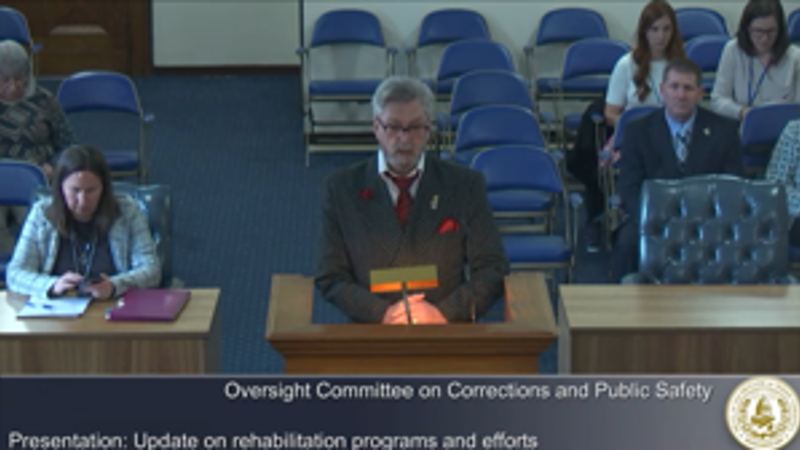
The West Virginia Division of Corrections and Rehabilitation detailed its juvenile, adult, and health care rehabilitation programs during an interim legislative meeting, updating lawmakers on services including vocational training, substance use treatment, reentry planning, and medication for opioid use disorder.
Juvenile Services and Programs
The Bureau of Juvenile Services operates 10 juvenile facilities statewide, along with a statewide youth reporting center and community-based service programs, according to assistant commissioner Shelby Searles. Eight facilities house detention residents who receive individual and group counseling, crisis intervention, recreation, family visitation, religious services, and educational programming aligned with West Virginia college- and career-readiness standards. Juvenile residents have access to GED preparation, credit recovery, and vocational programs including building construction and operations, automotive, welding, and personal wellness courses at select sites. Additional programming encompasses substance abuse treatment, sex offender programming, art and music therapy, gardening, and wellness initiatives.
The bureau’s court-ordered diagnostic services provide comprehensive 30-day evaluations for adjudicated youth. In 2025, the bureau completed 116 diagnostic evaluations. Youth reporting centers served as an alternative to detention, assisting 691 youth in 2025, while community resource coordinators provided aftercare services to 272 youth. Home detention programs served 73 youth across four counties, and a northern community intervention program served 75 youth.
Adult Reentry and Treatment Services
Misty Adams, director of adult offender services, detailed reentry initiatives designed to prepare incarcerated individuals for release, including accelerated parole options for nonviolent offenders, assistance obtaining identification documents, Medicaid enrollment, and job fairs within facilities. Adult facilities offer cognitive behavioral programs, substance use treatment programs including residential substance abuse treatment, DUI safety courses, domestic violence programming, and sex offender treatment. Educational and vocational offerings include GED preparation, building maintenance, automotive technology, cosmetology, culinary arts, barbering, and electrical training.
Medication for Opioid Use Disorder Expansion
Dr. Gary Davenport, director of correctional health care, outlined the division’s medication for opioid use disorder program, which uses evidence-based medications including buprenorphine and naltrexone. Participation has grown significantly since early 2023. According to Davenport, “Around June of 2023 we had about 900 patients per month,” with participation reaching 5,044 patients by December. Nearly all participants receive oral buprenorphine products. The program is funded through a $3.2 million federal grant to cover medication costs, and individuals leaving custody are provided Narcan unless they opt out.
This article is an AI-assisted summary. All facts and figures are drawn from the original report: https://www.wvnews.com/news/wvnews/west-virginia-division-of-corrections-and-rehabilitation-wv-division-of-corrections-highlights-vocational-reentry-and/article_08077e20-53cc-4df4-bebd-ae8fee496445.html