Nebraska’s rural behavioral health battle
 Eighty-eight of Nebraska’s 93 counties are designated Mental Health Professional Shortage Areas, according to theBehavioral Health Education Center of Nebraska.Nearly 95% of Nebraska counties are identified as having a shortage of mental health professionals, and 29 Nebraska counties have no behavioral health providers. Rural Nebraskans face barriers and challenges in accessing mental health services and care.
Culture, geographic location and accessibility are a few factors that impact mental health in areas like Nebraska’s Panhandle. Nearly one in five adults has a mental illness, according to theSubstance Abuse and Mental Health Services Administration.
The rate of rural Nebraska resident suicides was 20.2 people per 100,000 residents, while the urban Nebraska rate was 10.0 people per 100,000 residents from 2016 to 2022. Rural Nebraska has three practicing psychiatrists per 100,000 residents, compared to 11.8 per 100,000 residents in urban Nebraska.
Rural Nebraska has 8.7 practicing psychologists per 100,000 residents compared to Urban Nebraska’s 27.9, according toBHECN. Finding time to travel to appointments can be difficult and takes up a large chunk of the day.
Dr. Cate Jones-Hazledine said some patients drive up to an hour to appointments.
According toBHECN, some patients drive over an hour to reach a clinic. Tara Wilson, a LIMHP counselor at Western Nebraska Behavioral Health in Rushville, Nebraska, and associate professor at Chadron State College, said a barrier that many rural Nebraskans face in accessing mental health services is transportation.
There is minimal or no public transportation in rural areas, making it difficult for those who are isolated from services available in another town. Jones-Hazledine, a licensed psychologist and owner of Western Nebraska Behavioral Health, said transportation costs are additional barriers Nebraskans face. “One of the things that gets in the way of clients being able to travel to appointments is the cost of that, the cost of the gas,” Jones-Hazledine said. “Do they have a reliable car?
Can they afford to take the time off work that it takes to drive an hour to be seen and then have an hour appointment, and then drive an hour back?” Jones-Hazledine is a Rushville native and said she is driven by her mission to help underserved communities that have limited access to mental health services. She returned to Rushville as a faculty member of the Munroe-Meyer Institute with the University of Nebraska Medical Center.
Later, she converted the clinics into a private practice and expanded it to help her community. “I’m from here. That’s the biggest thing.
I came home,” Jones-Hazledine said. She has clinics in Rushville, Chadron, Crawford, Alliance, Scottsbluff and Valentine.
Jones-Hazledine said she sees the problem rural patients face – and meets them where they are at. “Distance is an obstacle because our communities are small and really spread out, and so folks very often have to travel a distance in order to access care,” she said. “That’s one of the reasons that we have seven different locations. To try to minimize some of that.” Despite efforts, stigma still lingers in communities Over the 21 years Cate-Hazeline has been practicing in Rushville, she said stigma around mental health is still very prevalent. “It is still an obstacle, I think, especially for certain parts of the population,” she said. “A lot of our clinicians are currently really worried about young adult men, especially because we are seeing higher rates of suicide, and that population is historically really hard to get into the clinic.” Wilson said the smaller community feel can impact one’s willingness to seek help. “Other barriers might even just be the small community feel.
While some clients want to know everything about their counselor before they go and meet with them, other clients don’t want to know a single thing about the counselor,” Wilson said. “So, it’s really just a kind of individual preference.
It’s really hard to go to a counselor that you know nothing about if you don’t want to go to a counselor that knows things about you already.” Quinn Lewandowski, who focuses on behavioral health policies at the Nebraska Public Policy Center in Lincoln and serves as the president of the Nebraska State Suicide Prevention Coalition, also said the small-town feel is impactful. Lewandowski said participants in focus groups described parking their vehicles a few blocks away from their therapist’s office to avoid being seen by others. “Folks like me, and a host of other organizations and partners are really trying to flip that script, or flip that narrative, and show that there are people out there that want to help and care and that there’s hope for folks.
Along the way, we’re trying to increase public health messaging around help seeking, and that asking for help is a sign of strength,” Lewandowski said. Lewandowski is working on suicide prevention messaging to reach audiences such as adult men and demographics that are not traditionally targeted.
The message is”Live up to a different kind of strength. The strength to ask for help.” Jones-Hazledine is trying to change the stigma in her community through her work with the schools by normalizing mental health care. “We’re collaborating with our local school system, and they identify students that they’re worried about, or students who have need, or the families identify students, and we go right into the schools, and we provide outpatient mental health, but we provide it in the schools,” Jones-Hazledine said.
She said she hopes that as children age, mental health practices and care will be normalized in their everyday lives and as an available resource. Despite improvements in providers, there is a need for psychiatrists and medication management, Wilson said.
Telehealth options are available; however, Wilson said some patients prefer in-person provider visits. “Telehealth is absolutely helping us to reach additional clients that we wouldn’t necessarily be able to reach,” Wilson said. “It’s just not everyone prefers, not everyone wants to do telehealth.” Jones-Hazledine said she has been using telehealth services for 14 years. In her practice, telehealth is supplemented with sessions to increase the frequency of care.
There is also a statewide shortage of behavioral health workers. BHECN is working to address behavioral health workforce gaps in Nebraska through recruitment, training, and retention.
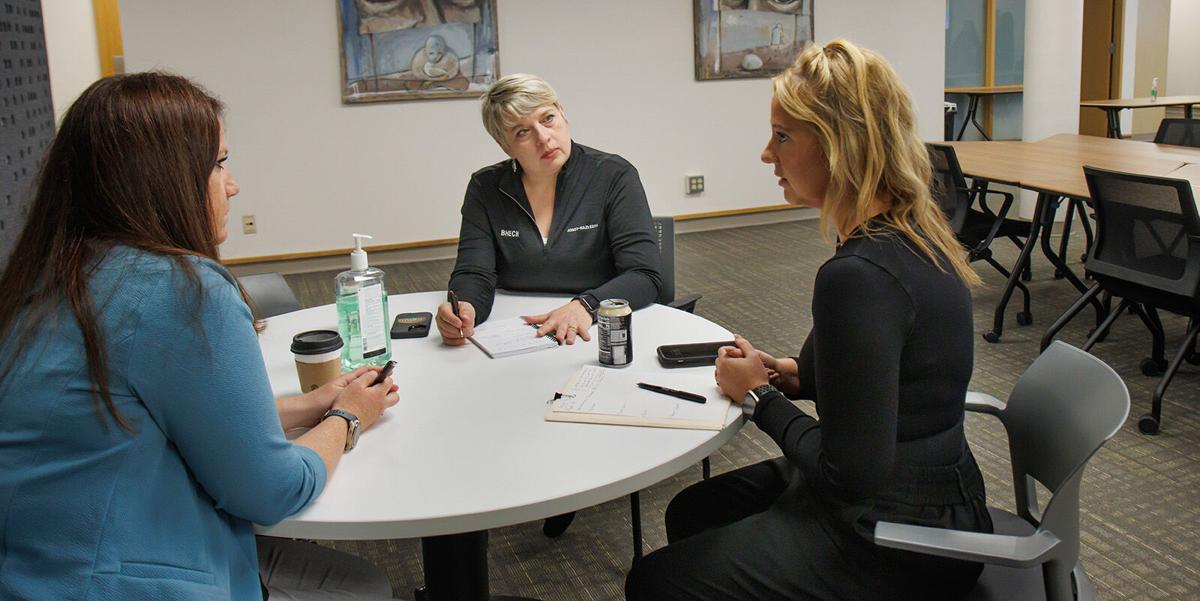
Dr. Catherine Jones-Hazledine (middle) is the co-director of BHECN’s Panhandle site.
She is a psychologist and the owner of Western Nebraska Behavioral Health in Rushville, Nebraska. According toBHECN’s 2025 Workforce Report, practicing behavioral health providers increased by 24% in rural Nebraska.
Psychiatric physician assistants increased by 267%, and licensed independent mental health practitioners increased by 225%. Despite improvements in Nebraska’s rural workforce, many residents still face long wait times and provider shortages.
Many still must drive over an hour to the nearest provider to seek in-person care.
Telehealth appointments cannot fully replace in-person services and care. Rural Nebraska is facing challenges to address the need for behavioral health care, but it is not going unnoticed.
Leaders in behavioral health are working together to address residents’ challenges and provide mental health services. Keep it Clean.Please avoid obscene, vulgar, lewd, racist or sexually-oriented language.PLEASE TURN OFF YOUR CAPS LOCK.Don’t Threaten.Threats of harming another person will not be tolerated.Be Truthful.Don’t knowingly lie about anyone or anything.Be Nice.No racism, sexism or any sort of -ism that is degrading to another person.Be Proactive.Use the ‘Report’ link on each comment to let us know of abusive posts.Share with Us.We’d love to hear eyewitness accounts, the history behind an article.