Legislature's cut to mental health services worries sheriffs
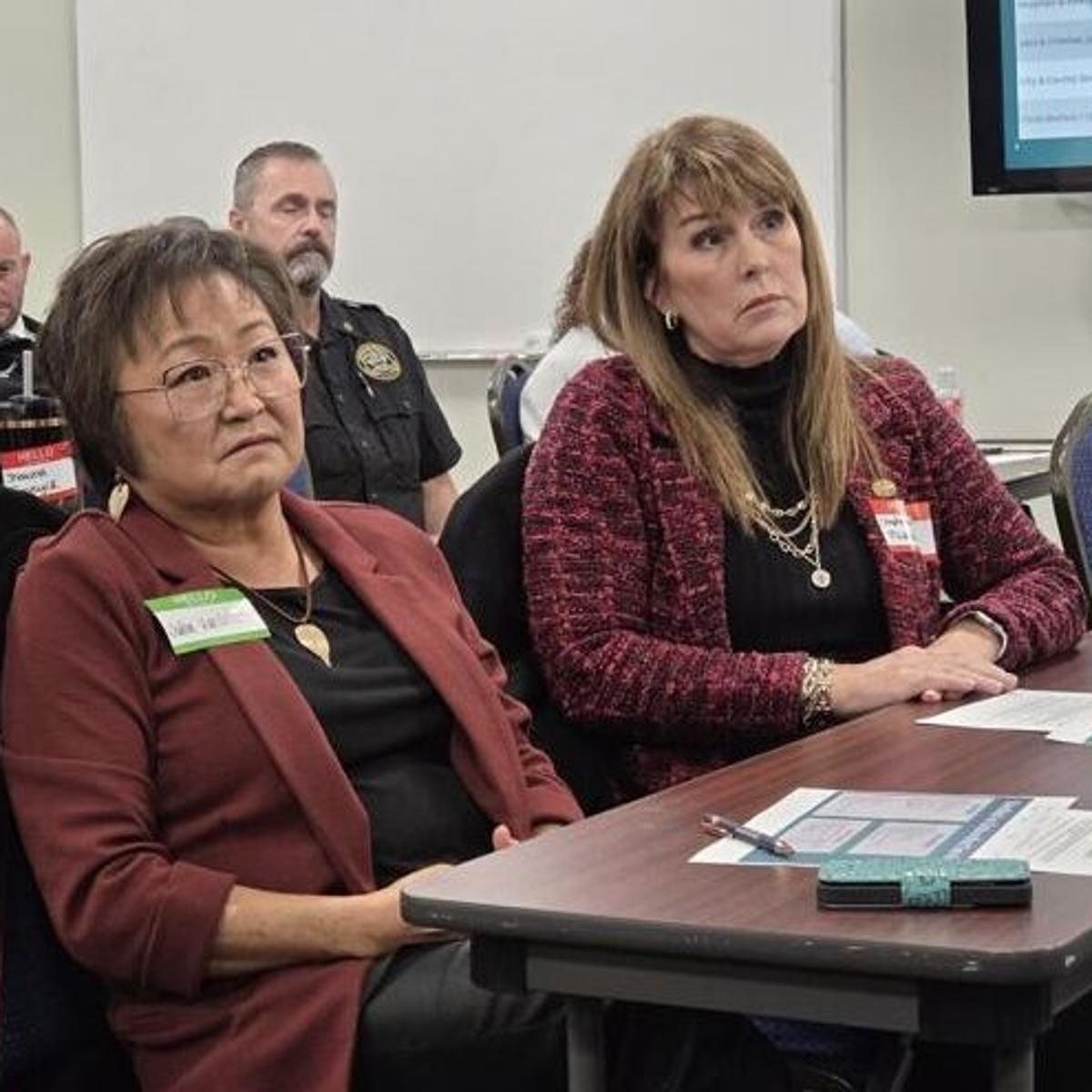 Idaho State Representatives Julie Van Orden and Stephanie Mickelsen attended Friday’s Ammon open house discussing behavioral health systems in Idaho. Mental health professionals, Idaho sheriffs and area legislators were among more than 60 people in attendance Friday for the Behavioral Health Open House at the Bonneville County Sheriff’s Office in Ammon.
The open house served as a warning call to residents across the state about the State of Idaho’s decision to discontinue several key behavioral health programs on Dec. 1. These reductions include elimination of Assertive Community Treatment (ACT) teams, Partial Hospitalization Programs, High Acuity Resource Teams, Peer Support, Early Serious Mental Health services as well as half-day Partial Hospitalization Programs and the 15-percent cut to Intensive Outpatient Program for people with Serious and Persistent Mental Illness (SPMI).
The contractor that runs Idaho Medicaid mental health benefits, Magellan of Idaho, plan to cut ACT teams that treat patients with severe mental illness who have struggled in routine settings. “We understand what happens when you tear down these kinds of services,” said Bonneville County Sheriff Sam Hulse, who recognized the sheriffs from Jefferson, Fremont, Bingham and Madison counties in attendance. “It’s not our first time to this rodeo with the State of Idaho,” Hulse said. “When you have things that are on a shoestring budget to begin with and we’re one of the least well-funded states in dealing with mental-health crises in our communities… and now the state comes in with a wrecking ball because they mismanaged the budget… “We’re here to tell you as sheriffs you’re going to have problems,” Hulse said. “And some of these programs are not going to be measured on a spreadsheet about budgets, but they’re going to be measured in human cost. That’s what I want to make sure everybody’s aware of and that’s why we’re in the room. “Our jails are the default mental institutions of this culture and have been ever since we deinstitutionalized the mentally ill,” Hulse said. “We all know that folks with mental illness are not any more prone to violence than anybody else.
But when they are in crisis, which is what we’re talking about here, they can be dangerous.
Anybody in crisis can be dangerous.” Tom Tueller, who owns Tueller Counseling Services in Idaho Falls and serves as ACT director for Region 7 in Idaho that stretches from Blackfoot to Salmon and Arco to Driggs, spoke about what these cuts mean if they stand. “We’re trying to bring everybody together to try to educate, especially the legislators, on what this is going to cost,” Tueller said. “The counties will start to suffer because of this.” An ACT team is a multidisciplinary group of 13 mental health professionals who provide intensive, wraparound support for adults with severe mental illnesses, helping them live independently in the community through home-based care, skill-building and coordination with other services. For example, Tueller explained what happens after a person who suffers a psychotic episode is transferred from jail to a usual stay of 32 days at State Hospital South in Blackfoot.
This adult inpatient psychiatric facility and skilled nursing home provides care for residents with SPMI. “They stabilize them and send them back out into the community,” Tueller said. “But where do they go?” Tueller asked. “Because most people lose their housing. They become homeless, and they don’t have their prescriptions.
They don’t have their doctors. They don’t have anybody there to pick them up and stabilize them. “That is what the ACT team is supposed to do,” Tueller said. “If we monitor them well, they usually stay out of the hospitals and jails.” Some people are seen by ACT teams for decades. “There’s going to be an impact if an ACT team is not there to stabilize these people,” Tueller said. “They will repeatedly go to jail, go to the hospital over and over and over if somebody’s not there.” Hulse agreed about the importance of ACT teams. “If we can’t keep people stable in the community, then they’re going to end up in the crisis services that mean the emergency rooms, that mean our jails,” Hulse said. “That puts an increased burden on law enforcement, and then when those calls don’t go well and we end up having to use force on somebody, we get blamed for it.” Tueller said ACT teams are currently in 36 states and originated 30 years ago. “They understood that these people will not go to regular (medical) services,” Tueller said. “They become very psychotic, very paranoid, and they do not go to regular services.
They will not go to our offices, sit down with our psychiatrist or anybody there and do regular counseling. “If they are medicated, they want to stay home and they want to stay away from people,” Tueller said. “And we’re there to help them and stabilize them.” “If ACT goes away, they will be in the hospitals and jails and homeless repeatedly,” Tueller said. With the state mandate to unbundle services, doctors and nurses can no longer visit patients. “What they’re actually saying is they are not going to pay for mileage anymore,” Tueller said. “Our people can’t go out. “(Patients) can come in for counseling,” Tueller said. “They can come in for medications.
That’s about it. The unbundling is going to destroy this system.
It doesn’t pay for nurses. It doesn’t pay for half the team.” The state’s projected budget deficit is coming after the Legislature and Gov.
Brad Little approved $450 million in tax cuts during the 2025 legislative session, following years of income tax cuts that have reduced the state’s revenue by $4 billion. Before the changes took effect in December, the ACT program served approximately 400 people statewide, Tueller said.
At full capacity it can serve 500 people. Ric Boyce, licensed clinical social worker and CEO at Mental Health Specialists of Pocatello, said the $13 million Idaho saves by eliminating the ACT program will ultimately cost the state’s counties and taxpayers $150 million in property taxes for increased incarcerations, hospitalizations and legal services.
Using statewide modeling and Region 7 service-utilization patterns, Region 7 is projected to experience between $18 million to $25 million per year in new downstream costs, Boyce said. These costs include hospitals, EMS, law enforcement, jails, shelters, courts and child welfare. “They say it’s going to be unbundled, but again that will destroy the program,” Tueller said.
Tueller said an appeal of the Legislature’s cut to mental health services went before a federal judge Friday. “I’m confident on Monday the federal judge will stay this,” Tueller said, to give the Legislature time to go into session and start to work this out. State Rep.
Julie VanOrden, a member of the audience, said “Medicaid expansion is going to be on the chopping block this year. They’re going to say we can pay for all these programs if we get rid of Medicaid expansion. “What happens if that happens?” VanOrden asked. “Because there probably are a lot of people that are in this that are on Medicaid expansion.” Stay relevant, be civil, re-read and re-think before you submit.
To view our latest e-Edition, click the image on the left. Search the complete digital archives for all papers in the Pioneer News Group.